Building Modern Web Applications with Next.js and MongoDB

Introduction
Modern web development has evolved significantly over the past decade. Businesses today require applications that are fast, scalable, secure, and capable of supporting a growing number of users.
Technologies such as Next.js, Node.js, and MongoDB have become some of the most powerful tools for building modern digital platforms.
At DigiDwell Technologies, we use these technologies to build modern web applications, business systems, and scalable digital solutions for organizations and startups.
Why Next.js?
Next.js is one of the most powerful frameworks built on top of React. It allows developers to build both frontend and backend functionality in one unified framework.
Some of the key advantages of using Next.js include:
Server-side rendering (SSR) for better performance
Static site generation (SSG) for faster loading pages
Built-in API routes for backend logic
Automatic routing system
Excellent SEO support
Modern developer experience
These features make Next.js an ideal choice for building high-performance applications and websites.
Using MongoDB for Modern Applications
MongoDB is a flexible NoSQL database designed for modern applications. Instead of storing data in rigid tables like traditional databases, MongoDB stores data in document-based formats that closely resemble JSON.
This makes MongoDB very flexible when building complex applications.
Some advantages of MongoDB include:
Flexible schema design
High scalability for large systems
Easy integration with Node.js
Cloud hosting with MongoDB Atlas
Excellent performance for modern APIs
Because of these benefits, MongoDB is widely used by modern startups and large technology companies.
Combining Next.js and MongoDB
When Next.js is combined with MongoDB, developers can create powerful full-stack applications.
A typical architecture looks like this:
Client (Next.js frontend)
↓
Server logic / API routes / Server Actions
↓
Service layer (business logic)
↓
MongoDB database
This structure allows applications to be clean, scalable, and maintainable.
Real World Applications
With this technology stack, businesses can build systems such as:
E-commerce platforms
School management systems
Hospital management systems
Business management dashboards
Logistics and transport systems
Data analytics platforms
These systems can handle large volumes of data while remaining fast and reliable.
Conclusion
Modern web development requires tools that are powerful, flexible, and scalable. By combining technologies such as Next.js, Node.js, and MongoDB, developers can build applications that meet the demands of today's digital world.
At DigiDwell Technologies, we focus on building reliable and scalable digital solutions that help businesses grow and operate efficiently in the digital age.
Related Articles
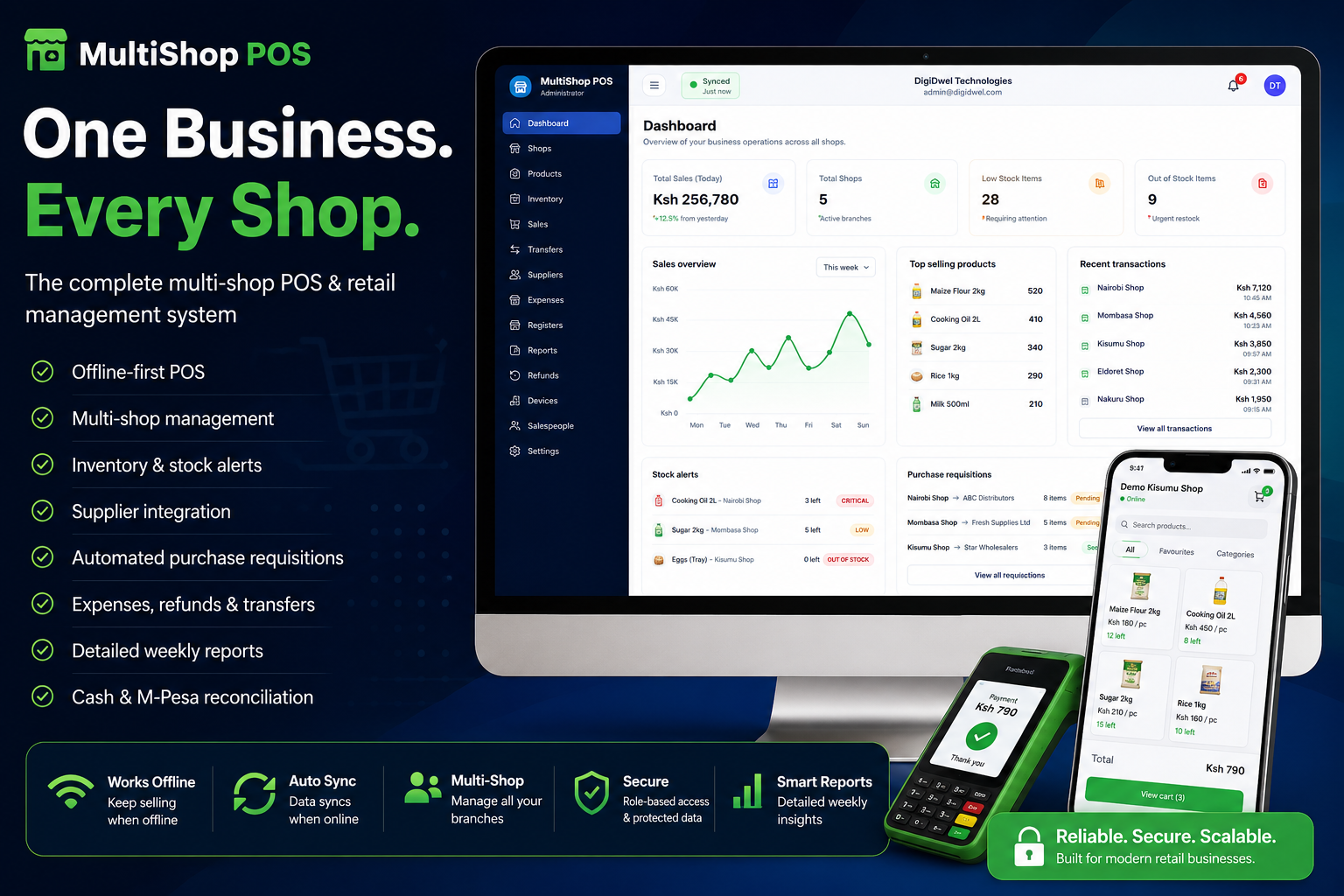
How MultiShop POS Works: A Complete Guide to the Shop & Administration Portals
MultiShop POS is a modern, offline-first retail management system designed to help businesses manage multiple shops from one centralized platform. It combines point-of-sale operations, inventory, sales, supplier management, automated purchase requisitions, cash and M-Pesa reconciliation, transfers, expenses, refunds, and detailed reporting in one secure system.